


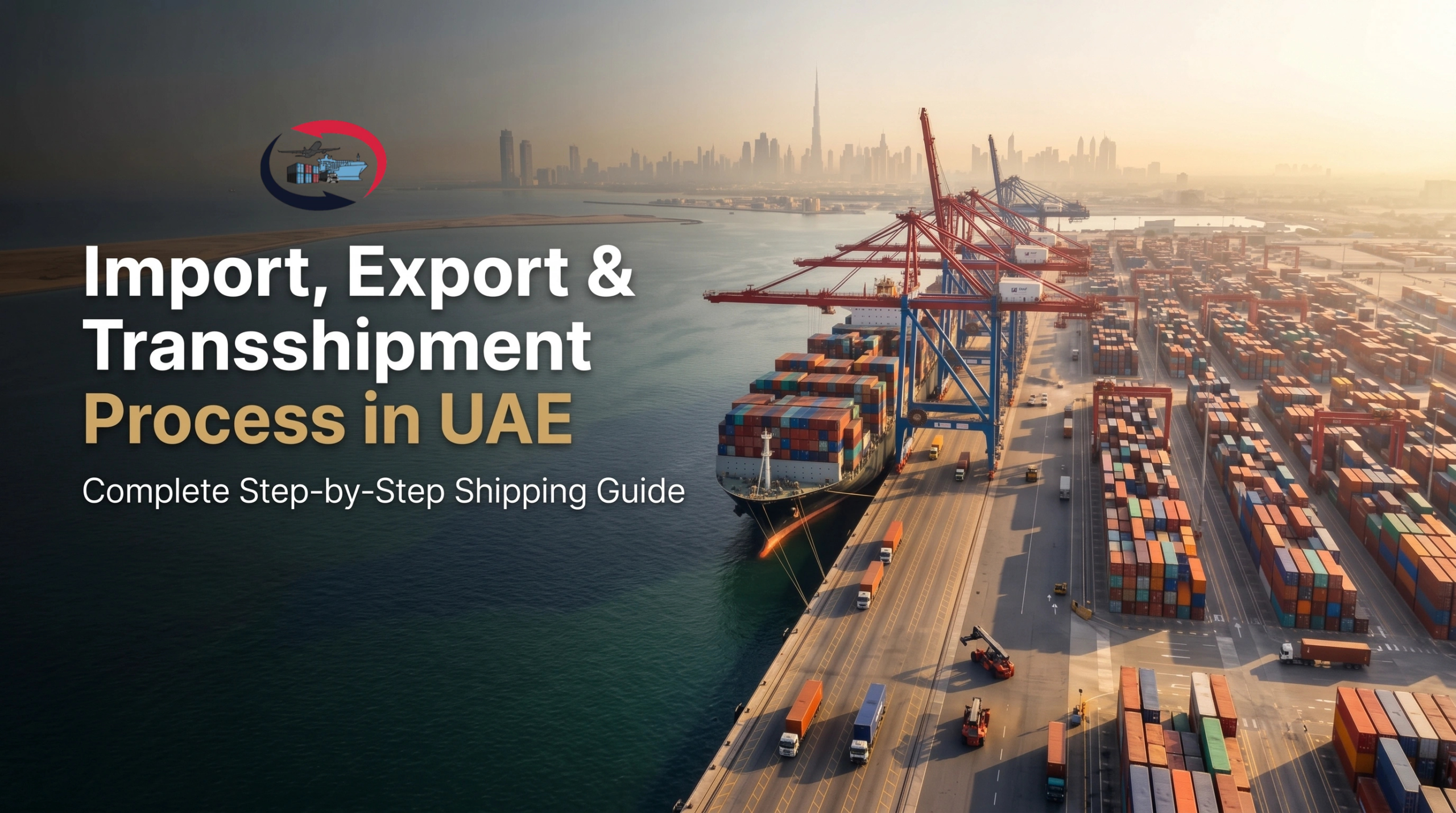
Import, Export & Transshipment Process in UAE: Complete Step-by-Step Shipping Guide
International shipping involves much more than moving cargo from one port to another. Every shipment passes through a structured process involving freight planning, carrier booking, documentation, customs procedures, terminal operations, cargo handling, transportation, and final delivery.
At Complete Shipping Services LLC (CSS), we support businesses with end-to-end logistics solutions across the UAE and international markets, including Sea Freight, Air Freight, Land Transportation, NVOCC Services, Customs Brokerage, Warehousing, Cross-Border Shipping, and Transshipment Services.
This guide explains how import, export, and transshipment processes in the UAE generally work, including the internal operational steps involved throughout the shipment lifecycle.
«Important: Customs procedures, documentation, duties, permits, terminal requirements, and cargo handling procedures vary according to shipment type, commodity, origin, destination, customs regime, and applicable UAE regulations. Shipment-specific requirements should always be verified before cargo movement.
Export Shipping Process from UAE

An export shipment involves moving cargo from the UAE to an overseas destination. The process begins before the cargo reaches the port or airport.
Step 1: Customer Enquiry & Shipment Assessment
The customer provides the basic shipment information to CSS. Shipment Details Required. These normally include:
- Port/Place of Loading
- Port/Place of Discharge
- Final Destination
- Commodity
- HS Code, where available
- Number of packages
- Gross and net weight
- Cargo dimensions
- Total CBM
- FCL or LCL requirement
- Container type
- Cargo-ready date
- Dangerous Goods status
- Incomers
- Pickup location
- Delivery requirement
- Commercial value where relevant
CSS Internal Processing
Our operations and pricing teams review:
- Cargo type and characteristics.
- Origin and destination.
- Required equipment.
- General or Dangerous Goods status.
- FCL/LCL suitability.
- Available carrier options.
- Direct or transshipment routing.
- Customs requirements.
- Pickup and transportation requirements.
- Special handling requirements.
This initial assessment helps us select an appropriate shipping solution.
2. Freight Rate Procurement & Quotation
After reviewing the enquiry, CSS obtains the relevant freight and operational costs.
Internal Processing
Our pricing team may coordinate with:
- Shipping lines
- Airlines
- NVOCC partners
- Overseas agents
- Transport companies
- Warehouses
- Customs representatives
- Terminals and handling partners
We review:
- Ocean or air freight
- Origin charges
- Destination information where available
- Documentation charges
- Terminal-related charges
- Transportation
- Customs clearance requirements
- Equipment availability
- Applicable surcharges
- Free time when relevant
- Estimated transit time
- Rate validity
CSS then prepares a freight quotation clearly identifying the services, applicable charges, validity, and relevant terms.
3. Booking Confirmation
Once the customer approves the quotation, the shipment moves to the booking stage. CSS Booking Process:
- Booking request is submitted to the selected carrier.
- Cargo details are declared.
- Required container/equipment is requested.
- DG details are submitted where applicable.
- Carrier confirms the booking.
- Vessel or flight schedule is reviewed.
- Cargo and documentation cut-offs are checked.
- Equipment release details are reviewed for containerized shipments.
- Booking confirmation is shared with the relevant parties.
For ocean exports, particular attention is given to applicable terminal gate-in, documentation, VGM, and DG cut-offs.
4. Cargo Pickup & Transportation
CSS can coordinate local transportation from the customer’s location to the required warehouse, CFS, airport cargo facility, or seaport terminal.
FCL Export
For Full Container Load shipments, the operational flow normally includes:
Empty Container Release → Container Positioning → Cargo Stuffing → Cargo Securing → Container Sealing → Export Processing → Terminal Gate-In
Container and seal details are recorded for documentation and operational control.
LCL Export
For Less than Container Load cargo:
Cargo Pickup → CFS/Warehouse Receiving → Weight & Dimension Verification → Cargo Segregation → Consolidation → Container Stuffing → Export Processing
Air Freight Export
Air shipments typically involve:
Cargo Pickup → Warehouse/Airport Receiving → Weight & Dimension Verification → Security/Acceptance Processing → Export Customs → Airline Handling → Flight Loading
5. Export Documentation
Correct documentation is essential for smooth international shipping. Depending on the shipment, documents may include:
- Commercial Invoice
- Packing List
- Certificate of Origin
- Export Customs Declaration
- Shipping Instructions
- Bill of Lading
- Sea Waybill
- Air Waybill
- Export Permit, where required
- Dangerous Goods Declaration
- Safety Data Sheet, where applicable
- Inspection certificates
- Other commodity-specific approvals
CSS Documentation Verification
Before processing, relevant information is checked for consistency, including:
- Shipper
- Consignee
- Notify party
- Commodity description
- Package quantity
- Gross/net weight
- Container number
- Seal number
- Marks and numbers
- HS code information where applicable
- Country of origin
- Freight terms
- Incomers
- Port of loading
- Port of discharge
- Final destination
Documentation accuracy helps prevent avoidable customs and carrier delays.
6. UAE Export Customs Clearance
The export declaration is processed according to the applicable UAE customs procedure and customs jurisdiction.
Typical Processing
- Depending on the shipment and customs regime, processing may include:
- Review of commercial documents.
- Verification of commodity information.
- HS classification review.
- Preparation of the customs declaration.
- Submission of supporting documents.
- Permit/approval verification where applicable.
- Customs inspection if selected.
- Resolution of customs queries.
- Customs release/export authorization.
Once customs and terminal requirements are satisfied, cargo can proceed for loading.
7. Terminal Handling & Vessel Loading
For sea freight, the loaded container enters the nominated terminal according to the carrier booking and terminal requirements. The operational flow generally becomes:
Terminal Gate-In → Container Yard → Vessel Planning → Loading Sequence → Vessel Loading → Departure
For air freight:
Cargo Terminal Acceptance → Security/Handling → Flight Planning → Aircraft Loading → Departure
8. Bill of Lading / Air Waybill Processing
After cargo acceptance and according to the carrier’s documentation process, the relevant transport document is finalized. For sea freight this may include:
- Original Bill of Lading
- Sea Waybill
- Surrendered Bill of Lading arrangement
- Electronic/Telex Release where applicable
For air freight:
- Air Waybill
CSS coordinates shipping instructions and checks the transport-document details before finalization.
9. Destination Pre-Alert
Once the shipment is moving, relevant documents and shipment information can be sent to the destination agent or consignee. The pre-alert commonly includes:
- Bill of Lading/Air Waybill
- Commercial Invoice
- Packing List
- Certificate of Origin where applicable
- Container details
- Vessel/flight details
- ETA
- Cargo information
- Special instructions
- Relevant supporting documents
This enables the destination team to prepare for import clearance before arrival.
UAE IMPORT PROCESS

10. Import Pre-Alert & Document Review
For UAE imports, CSS reviews available shipment documents before arrival whenever possible.
Internal Processing
Our team may check:
- Consignee details.
- Bill of Lading/Air Waybill information.
- Commercial Invoice.
- Packing List.
- Commodity description.
- HS code information.
- Country of origin.
- ETA.
- Permit requirements.
- Customs-clearance requirements.
Early document review can identify potential issues before cargo reaches the UAE.
11. Vessel / Flight Arrival Monitoring
CSS monitors the shipment’s estimated arrival. Operational activities can include:
- Vessel tracking
- Flight monitoring
- ETA updates
- Document follow-up
- Coordination with carrier/agent
- Customs document preparation
- Customer notification
If the schedule changes, updated arrival information can be communicated accordingly.
12. Import Manifest & Arrival Processing
The carrier or authorized agent completes applicable cargo manifest and arrival procedures according to UAE customs, port, airport, and carrier requirements.
The exact workflow depends on the mode of transport, customs jurisdiction, cargo type, and terminal.
13. UAE Import Customs Clearance
Once the required documentation and arrival information are available, the import declaration can be processed under the applicable customs procedure. Customs processing may include:
- Commercial Invoice review.
- Packing List review.
- Bill of Lading/Air Waybill verification.
- HS classification.
- Customs-value determination.
- Country-of-origin review.
- Permit verification.
- Import declaration submission.
- Customs assessment.
- Payment/settlement of applicable customs duty and taxes.
- Inspection or scanning where required.
- Customs release.
CSS provides customs brokerage and clearance support for eligible shipments in accordance with applicable procedures.
14. Customs Duty, VAT & Regulatory Charges
Import costs depend on several factors, including:
- Commodity
- HS classification
- Customs value
- Country of origin
- Applicable customs regime
- Trade arrangements
- Import permits
- UAE tax and customs rules
Applicable duties and taxes should therefore be calculated according to the specific shipment rather than assumed as a universal percentage for every cargo movement.
15. Customs Inspection & Cargo Examination
Not every shipment follows the same customs-control process. Depending on risk assessment and regulatory requirements, cargo may be subject to:
- Documentary review
- Scanning
- Physical examination
- Sampling
- Permit verification
- Inspection by another competent authority
CSS coordinates the operational requirements associated with the shipment where such inspection is required.
16. Delivery Order & Cargo Release
Customs clearance alone may not complete the entire cargo-release process. Before pickup, relevant requirements may include:
Customs Release + Carrier Release + Transport Document Release + Applicable Charges + Terminal/CFS Release
For sea freight, a Delivery Order or equivalent carrier release process may apply depending on the shipment and carrier. CSS coordinates these operational steps before arranging cargo collection.
17. Import Container / Cargo Pickup
Once all required releases are completed, cargo can be collected.
FCL
Terminal Release → Truck Assignment → Container Pickup → Customer Delivery → Unloading → Empty Container Return
Empty containers should be returned according to carrier instructions and within the applicable free-time conditions to avoid additional charges.
LCL
Container Arrival → CFS Transfer → Deconsolidation → Individual Shipment Release → Cargo Pickup → Delivery
Air Freight
Airport Cargo Release → Customs Completion → Handling Release → Vehicle Assignment → Final Delivery
18. Final Delivery
CSS can coordinate delivery from the port, airport, CFS, or warehouse to the customer’s nominated location. The transport team manages:
- Vehicle selection
- Pickup scheduling
- Driver coordination
- Cargo/container collection
- Delivery monitoring
- Proof of Delivery
- Empty-container return where applicable
19. Shipment Closure
After successful delivery, the shipment file can be finalized. Internal closure may include:
- Proof of Delivery
- Customs documents
- Supplier invoices
- Carrier invoices
- Transport invoices
- Customer billing
- Cost reconciliation
- Shipment profitability review
- Document archiving
- Operational closure
UAE TRANSSHIPMENT PROCESS

20. What Is Transshipment?
Transshipment occurs when cargo arriving from one origin is transferred at an intermediate hub to another vessel, aircraft, or transport service before continuing to its final destination. A typical sea-freight routing may look like:
Origin Port → Jebel Ali / UAE Hub → Connecting Vessel → Final Destination
The cargo is not necessarily imported into the UAE domestic market. Instead, it may remain under the applicable customs-controlled transshipment or transit procedure before onward movement.
21. Transshipment Planning
Before cargo moves, CSS and its partners review:
- Origin
- UAE transshipment hub
- Final destination
- First-leg carrier
- Connecting carrier/service
- Cargo type
- Equipment
- Connection schedule
- Estimated transit time
- Customs/transit requirements
- Special cargo restrictions
The objective is to create a workable connection while complying with carrier, terminal, and customs requirements.
22. First-Leg Shipment
At origin, cargo completes the required export process:
Booking → Documentation → Export Customs → Terminal Handling → Loading → Departure
Cargo then moves toward the UAE transshipment hub.
23. Arrival at UAE Transshipment Hub
Upon arrival, cargo is discharged from the incoming vessel or transport service. Typical operational processing may include:
- Cargo/container discharge.
- Terminal system update.
- Placement in the designated transit/transshipment area.
- Connection with the onward booking.
- Applicable customs/transit processing.
- Connecting-vessel planning.
24. Customs-Controlled Transshipment Processing
Transshipment cargo remains subject to the applicable customs and terminal controls. Depending on the exact movement, processing may require:
- Manifest information
- Transit/transshipment declaration
- Customs authorization
- Bond/guarantee arrangements where applicable
- Cargo transfer documentation
- Terminal transfer procedures
- Regulatory approvals
- Security requirements
The applicable procedure must be determined according to the actual cargo movement and UAE customs regime.
25. Connection & Onward Vessel Planning
The connecting shipment is monitored carefully. CSS operations may monitor:
- First-vessel arrival
- Discharge status
- Customs/transit status
- Cargo availability
- Connecting-vessel schedule
- Terminal cut-off
- Loading status
- Revised ETA
If the planned connection cannot be achieved, the carrier or operations team coordinates the next available suitable connection.
26. Onward Loading
After applicable customs, terminal, and carrier requirements are completed:
Cargo Availability → Terminal Planning → Transfer/Positioning → Connecting Vessel Loading → Departure Confirmation
The cargo then continues toward the final destination.
27. Final Destination Processing
At the final destination, the cargo enters the applicable import process:
Arrival → Import Manifest → Customs Declaration → Customs Assessment → Duty/Tax Processing → Customs Release → Carrier/Terminal Release → Pickup → Final Delivery
Cross-Stuffing & Cargo Transfer Services
Some international logistics movements may require cargo to be transferred between containers or transport units under an approved operational and customs procedure.
Depending on the shipment, this may involve:
- Receiving the inbound cargo/container.
- Obtaining applicable permissions.
- Moving cargo to an authorized handling location.
- Opening the original container.
- Unloading cargo.
- Inspecting/counting cargo where required.
- Preparing the receiving container.
- Reloading or cross-stuffing.
- Securing cargo.
- Applying the new seal.
- Updating container and seal information.
- Completing required customs/terminal documentation.
- Moving the outbound container to the terminal.
- Loading onto the onward vessel.
CSS can coordinate cross-stuffing and related cargo-handling solutions based on the applicable customs and terminal requirements.
Bonded Warehousing & Cargo Handling
CSS also supports customers requiring warehousing and cargo handling in the UAE. Services can include:
- Cargo receiving
- Storage
- Palletization
- Packaging
- Labelling
- Cargo segregation
- Consolidation
- Deconsolidation
- Cross-stuffing
- Container stuffing
- Container de-stuffing
- Inventory handling
- Dispatch coordination
Bonded cargo must remain under the applicable customs controls and authorized procedures.
Dangerous Goods Shipping
CSS can support eligible Dangerous Goods shipments by sea, subject to commodity classification, carrier acceptance, and regulatory requirements. Depending on the cargo, information and documents may include:
- UN Number
- Proper Shipping Name
- Hazard Class
- Packing Group where applicable
- Dangerous Goods Declaration
- Safety Data Sheet
- Correct packaging
- Marks and labels
- Container packing information
- Carrier DG approval
- Terminal approval
- Applicable segregation requirements
For maritime shipments, Dangerous Goods transportation must comply with applicable regulations, including the IMDG Code.
CSS International Freight Services
Complete Shipping Services LLC provides integrated logistics solutions including:
- Sea Freight
- FCL Shipping
- LCL Shipping
- Air Freight
- NVOCC Services
- UAE Customs Brokerage
- Import Customs Clearance
- Export Customs Clearance
- Transshipment Services
- Cross-Stuffing
- Bonded Warehousing
- Land Transportation
- Door-to-Port Shipping
- Port-to-Door Delivery
- Cross-Border Transportation
- Cargo Packaging & Labelling
- Dangerous Goods Handling
- International Freight Forwarding
Complete CSS Export Workflow
Customer Enquiry → Shipment Assessment → Rate Procurement → Quotation → Customer Approval → Carrier Booking → Equipment/Cargo Planning → Pickup → Stuffing/Receiving → Documentation → Export Customs → Terminal Gate-In → Loading → Departure → BL/AWB Processing → Destination Pre-Alert
Complete CSS Import Workflow
Pre-Alert → Document Verification → ETA Monitoring → Arrival → Manifest Processing → Import Declaration → Customs Assessment → Duty/Tax Processing → Inspection if Required → Customs Release → Carrier/DO Release → Terminal/CFS Release → Cargo Pickup → Delivery → POD → Shipment Closure
Complete CSS Transshipment Workflow
Origin Booking → Export Clearance → First-Leg Loading → Departure → UAE Hub Arrival → Discharge → Transit/Transshipment Processing → Customs/Terminal Control → Connecting Vessel Planning → Onward Loading → Departure → Final Destination → Import Clearance → Delivery
Why Choose Complete Shipping Services LLC?
International freight requires coordination between multiple parties. CSS provides a single logistics coordination point to help customers manage cargo movements efficiently. Our solutions combine:
- Freight forwarding expertise
- UAE customs support
- NVOCC solutions
- Sea and air freight
- Local transportation
- Warehousing and cargo handling
- Transshipment coordination
- Cross-border logistics
- Overseas partner network
- Shipment documentation support
- End-to-end operational coordination
From a single shipment to regular international cargo movements, our objective is to provide reliable and practical logistics solutions based on each customer’s requirements.
Frequently Asked Questions
What is the import process in UAE?
The UAE import process generally involves shipment arrival, manifest processing, import documentation, customs declaration, customs assessment, applicable duty/tax processing, inspection where required, customs release, carrier/terminal release, cargo pickup, and final delivery.
How does export customs clearance work in UAE?
Export clearance generally requires preparation and submission of the applicable customs declaration with commercial and supporting documents. Additional permits or inspections may apply depending on the commodity and customs procedure.
What is transshipment in Jebel Ali?
Transshipment generally refers to cargo arriving at Jebel Ali or another UAE hub from one origin and subsequently being transferred to another vessel or service for transportation to its final destination while remaining subject to the applicable customs and terminal controls.
What is the difference between import and transshipment?
Imported cargo enters the UAE under an applicable import customs procedure, while transshipment cargo generally passes through a UAE logistics hub for onward transportation without entering domestic circulation under a normal import process.
Can CSS handle FCL and LCL shipments?
Yes. CSS provides both FCL and LCL freight-forwarding solutions according to cargo volume, routing, destination, and customer requirements.
Does CSS provide customs clearance in UAE?
CSS provides customs brokerage and clearance support for eligible import and export shipments according to applicable UAE customs procedures.
Can CSS arrange door delivery?
Yes. CSS can coordinate local transportation and port-to-door or other applicable delivery solutions depending on the shipment.
Does CSS handle Dangerous Goods?
CSS can coordinate eligible Dangerous Goods sea shipments subject to correct cargo classification, documentation, carrier acceptance, and applicable regulatory requirements.
What documents are normally required for international shipping?
Common documents include the Commercial Invoice, Packing List, Bill of Lading or Air Waybill, Certificate of Origin where required, customs declaration, and commodity-specific permits or certificates where applicable.
How can I request a freight quotation from CSS?
Provide the origin, destination, commodity, weight, dimensions/CBM, container requirement, cargo-ready date, and pickup/delivery requirements. Our team can then review the shipment and prepare an appropriate freight solution.
Ship with CSS
Need assistance with Import, Export, Transshipment, Sea Freight, Air Freight, Customs Clearance, NVOCC, Warehousing, or Land Transportation in the UAE?
Complete Shipping Services LLC can coordinate your shipment from initial planning and freight booking through customs processing, cargo handling, transportation, and final delivery.

3 comments on “Import, Export & Transshipment Process in UAE: Complete Step-by-Step Shipping Guide”