


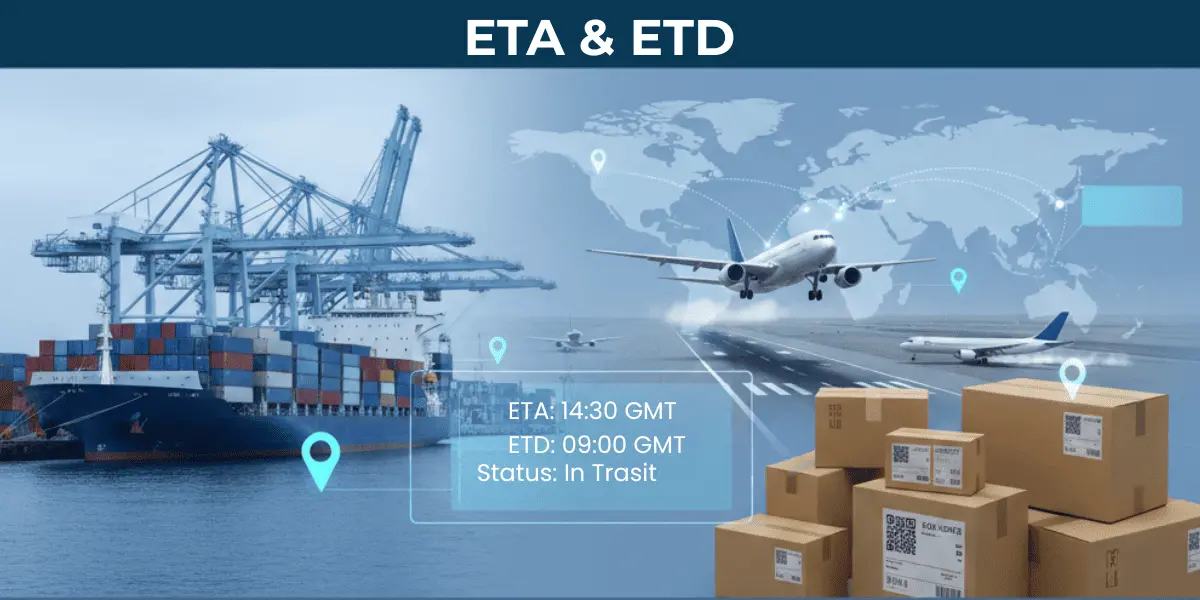
Have you ever wondered how your delivery travels across the globe and arrives at your door promptly? This is when ETD and ETA are useful. To put it simply, the Estimated Time of Arrival (ETA) in shipping refers to the anticipated arrival time of a shipment at its destination. However, the Estimated Time of Departure (ETD) complete form in the field indicates when a flight or weight is scheduled to depart. Despite their seeming insignificance, these phrases are crucial to the seamless, efficient, and predictable operation of international trade, travel, and delivery.
The definitions of ETD and ETA in logistics will be explained in this article, along with the reasons why they are important for shipping and supply chain management.
What is the Estimated Time of arrival in Shipping?
The Estimated Time of arrival in Shipping is referred to as ETA. It shows you when you may anticipate receiving your weight. Usually, the shipping company provides this information.
- ETA is simple in logistics: The Things are easier to track down. You don’t have to speculate as to when the goods will be delivered. The expected time and date were known to you.
- This is not an isolated incident: The ship’s current position is confirmed by the shipping company. They also keep an eye on Presto’s pace. They also look into decline, harbourage business, and customs detainments. After that, they give you an estimated time.
What does ETD mean in shipping?
The full word used in shipping is Estimated Time of Departure (ETD). It shows the anticipated time and date of your cargo’s departure from the harbour. This helps you make better plans. On the other hand, you can predict when your weight could reach its destination if you know when it leaves. It also helps you find out if there are any detentions.
The ETD full form for the field is the same. It shows the anticipated takeoff time of an aircraft. In both cases, it gives you a clear idea of where to start.
Let’s illustrate. Your products are ready in Chennai. The shipping company states that the ETD is May 7 at 9 AM. This means that your weight will leave the harbourage on that day and time.
Difference between ETA and ETD
ETA and ETD are two terms that are commonly used in shipping. You see objects as you move or enter them. The arrival time of a commodity is referred to as ETA. The ETD full form can be used to determine when a commodity departs. With both, you can trace your shipment more effectively.
|
ETA |
ETD |
|
In logistics, the full form of ETA is Estimated Time of Arrival. |
Estimated Time of Departure is the full form of ETD. |
|
ETA displays the anticipated arrival time and date of a cargo |
ETD provides the anticipated departure time and date of a cargo. |
|
The receiving side is the main emphasis of ETA. |
The transmitting side is the emphasis of ETD. |
|
When waiting for items, people frequently check the estimated time of arrival. |
The ETD is typically checked by shippers. |
How Can I Find Out When My Order Will Be Shipped?
The estimated time of arrival (ETA) tells you when your shipment is expected to reach its destination. Sophisticated methods are not required to get an estimated ETA. Just follow a few simple instructions.
Note the Departure Time: First, record the departure time and calculate the ETD. This is the expected time of departure. The cargo is shown when it leaves the harbourage or site.
Check the Transit Time: Next, estimate the time it will take for the package to reach its destination. The route, descent, distance, and manner of conveyance all affect this.
The two values are added together: Now add the departure time and the vehicle time. The result is your ETA.
The formula:
ETA = ETD + Transit Time
Detentions can occasionally result in further delays. These might be brought on by harbourage business, bad luck, or customs inspections. Remember to factor in some buffer time.
How is ETD Determined in Logistics?
When the cargo is expected to depart, the beginning location is indicated by ETD. This moment is not random. It is dependent on several significant items.
Carrier Schedule: Shipping firms adhere to set timetables. Based on the timetable, they determine the departure time.
Booking Confirmation: Only once the booking is confirmed is the reservation substantiation ETD final. The time is approved after a spot is set aside on the truck, plane, or ship.
Port or Terminal Vacuity: The departure may be delayed if the harbourage is congested. Thus, the harbourage business is a major factor in determining the ETD.
Checks for Customs and Clearance: Before leaving, goods must be cleared. The ETD may be shifted by any paperwork or examination detention.
The state of the weather: The departure time might be accelerated by a heavy downpour. If storms or other circumstances impact the travel, carriers modify the ETD.
Cargo Preparedness: The carrier may remain or register if the goods is not packed or prepared on time. This has an impact on the ultimate ETD.
Why Are ETD and ETA Important in the Supply Chain?
Everything in the force chain is kept on course by ETA and ETD. It is simpler to arrange, move, and deliver things on schedule when you know when they will arrive and depart.
- Reduces delays: ETA and ETD assist you in avoiding spending time at distribution centres, warehouses, or harbours.
- Enhances preparation: You can better organise your staff, transportation, and space if you know when items are coming in or going out.
- Keeps visitors satisfied: You may provide your customers with accurate delivery dates by using an accurate ETA.
- Saves money: Clear ETD allows you to better handle labour, storage, and exchanges. This reduces handling expenses and spare charges.
- In order to run operations, warehouses and business harbours require accurate ETD and ETA. Confusion and pile-ups are avoided in this way.
What difficulties arise while estimating ETA?
It’s not always simple to predict the precise ETA (Estimated Time of Arrival). Along the journey, several things can go wrong. ETA may also be impacted by a number of frequent issues.
Slow goods on busy roads: Deliveries should be made as soon as possible in cosmopolitan areas where commerce is high. Detentions are a frequent result of congested highways. In fact, even if the product is ready to travel, it could not arrive on time due to traffic jams, particularly during rush hour.
Inadequate or Imprecise Addresses: When guests don’t give precise or comprehensive delivery addresses, confusion results. Delivery workers waste time looking for the best site, or worse, the product can wind up in the wrong place.
Manual Parcel Handling Takes Time: It takes time to handle parcels by hand. Many warehouses still sort packages by hand. Workers separate packages according to their routes, sizes, and destinations. However, the entire process is significantly hindered if there is a backlog or personnel infractions.
Weather Could Change: Unfavourable weather could be a major factor in delivery delays. Heavy rain, snow, storms, or fog can stop or slow down cars, aeroplanes, and even ships. This has a direct effect on the package’s arrival time.
Advantages of Precise ETA for Shipping
Everything goes more smoothly when you know exactly when a cargo will arrive. Businesses and visitors can benefit from an accurate ETA (Estimated Time of Arrival) in several ways. Additionally, this is how
- Satisfied customers: Feel more in control when they know when their order will be delivered. On-time delivery fosters trust and lessens misunderstanding.
- Improved Stock Planning: Precise ETAs facilitate improved force management in warehouses. It keeps supplies from running low or being kept in excess. This preserves capitalism and maintains equilibrium.
- Reduced Delivery Fees: You don’t need to pay more for hurried handling or storage if you know when the products will arrive. Smoother operations and reduced spare costs result from fewer last-minute adjustments.
- Better routes for deliveries: When ETAs are clear, delivery routes may be planned more efficiently. This saves energy, avoids long detentions, and guarantees that every vehicle is used correctly.
- Minimised Delivery Problems: Delays or missed deliveries cause issues. Accurate ETAs reduce the possibility of failed attempts, additional passes, and irate guests.
Conclusion
ETD and ETA are crucial for managing logistics and meeting customer needs in shipment. They enhance business planning and support detentions. Precise scheduling increases process efficiency by ensuring on-time delivery.