

Introduction
Buyers and sellers want to know who pays for items and who bears the risk. Transporter Paid To, often known as CPT, is an international commercial term, or incoterm, that may help you solve the questions above. Once you understand how CPT works, it will be easy to plan the delivery procedure without surprises. This blog will teach you all you need to know about CPT in a simple, clear, and concise manner.
What is Carriage Paid To (CPT)?
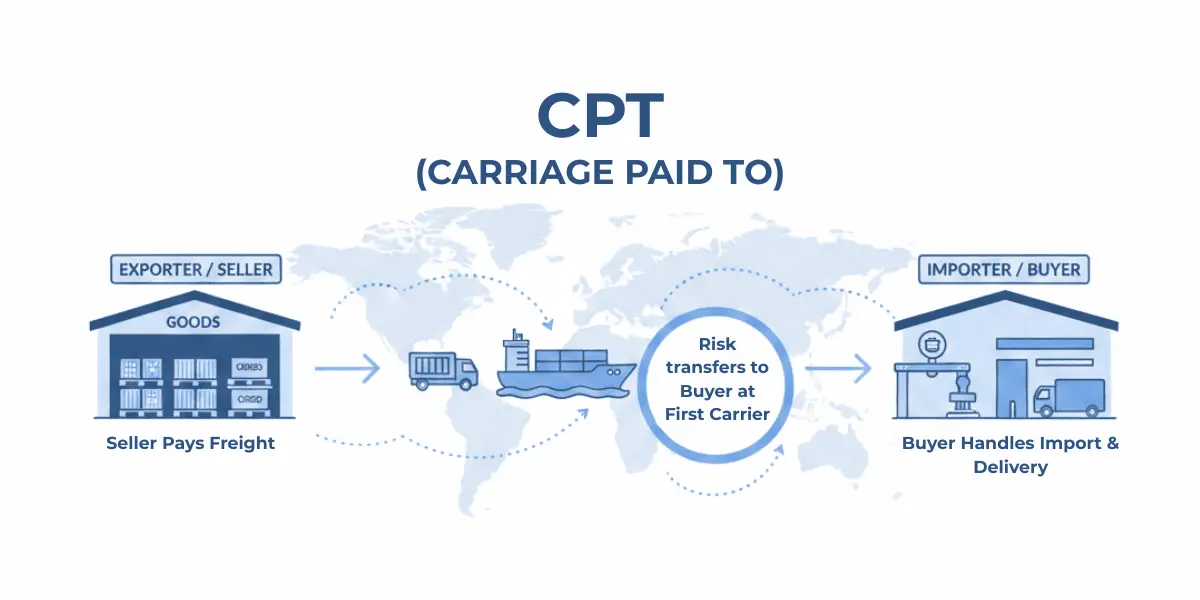
Carriage Paid To, or CPT, is an invoice in which the seller pays to deliver goods to a carrier at an agreed-upon location. The seller bears the expense and liability till the products arrive. Once the carrier gets them, the risk is transferred to the other party. This carrier might transport the products via land, train, air, or sea.
The seller manages export clearance, hires the carrier, and pays for transportation costs up to the moment of handover. If something goes wrong before the goods reach the transporter, it is the seller’s obligation. They are not liable for any subsequent loss or damage.
Some costs, such as Terminal Handling costs (THC), may be incorporated into the CPT price. It is usually preferable to check this in the contract. So, in CPT, the seller pays until the items are delivered to the carrier.
Example of Carriage Paid to (CPT)
Assume you are a Mumbai resident who is purchasing electronic components from a supplier in Germany. You have both agreed to utilise Carriage Paid To. The vendor pledges to deliver the goods to a carrier at the Frankfurt Airport. The seller will pay for shipping, export tariffs, and customs paperwork in Germany. However, after the products are handed over to the aircraft in Frankfurt, the risk is transferred to you.
Assume that the vehicle transporting the products from the seller’s warehouse to the airport is involved in an accident and the cargo is destroyed. If the items have already been formally delivered to the trucking firm (the first carrier), the seller is no longer accountable. You assumed the risk when you agreed to the CPT conditions. If you failed to insure the items, you are responsible for the loss.
Under CPT conditions, the seller is not required to pick the safest or most costly mode of shipping. They merely have to guarantee that the products reach the transporter. Also, in CPT, the vendor may not always deliver to the final destination. You can both agree on a middle ground. Perhaps you know a small airline in India that gives cheaper pricing, so you ask the vendor to ship solely to Delhi. That is permitted as CPT regardless if you both agree.
What are the seller’s responsibilities under CPT?
The seller has numerous important obligations under Carriage Paid To, or CPT, agreements before the goods are handed over to the first carrier. Let’s go over each of these responsibilities one by one.
Packaging:
The merchant must adequately pack the products for overseas shipping. The packing should safeguard the objects on their voyage. It must be appropriate for both the product type and the mode of transportation. Fragile articles, for example, require additional care, whereas moisture-sensitive commodities necessitate waterproof packing.
Loading Fees:
The seller must bear the expense of putting the items into the shipping container or vehicle that will transport them to the carrier. This includes any labour or material expenditures incurred at the seller’s storehouse or factory.
Delivery to Agreed Location:
It is the seller’s responsibility to transport the items from their current location to the port or another site where they will be handed over to the carrier. The seller has the option of choosing a transportation firm.
Origin Terminal Handling Charges:
The vendor is required to pay charges at the origin terminal. These are the costs charged by the terminal for processing goods before they are put onto the main carrier. It entails transporting, inspecting, and preparing the items for the following phase.
Loading on the Main Carrier:
Once the products arrive at the port or airport, the vendor will load them into the main mode of transportation, such as a ship or plane. They must pay all loading costs and ensure that the products are loaded appropriately. If something goes wrong at this phase before transfer, the seller is liable for the damages.
Freight Charges:
The seller has to shell out for products, and that includes the expense of transporting the items to the designated location with the buyer’s approval.
Destination Terminal Handling Charges:
Even when the items arrive at their destination, the seller must cover some expenses. Destination Terminal Handling Charges are costs levied at the buyer’s home country’s airport. These fees include the processing of the products after they arrive.
What are the buyer’s responsibilities under CPT?
Under the CPT agreement, the seller is responsible for the goods only until they are delivered to the first carrier. Following that, it is your job as the buyer to ensure the products arrive securely. The buyer’s duties are described below.
-
Insurance: After the vendor has handed over the items to the carrier, the buyer is responsible for obtaining insurance. If the products are lost or damaged in transportation, the customer bears the loss unless they have insurance.
-
Transport to the final destination: When the goods arrive at the destination country’s port or airport, it is the buyer’s responsibility to arrange for transportation to the warehouse or final address.
-
Unloading the goods: Once the products arrive at their destination, the buyer is responsible for unloading them. This involves hiring people or using a local business to unload the package.
-
Customs, Import Duties, and Taxes: The purchaser must clear the items via customs in the destination country. This includes paying import tariffs and taxes according to local laws. The buyer should be aware of the applicable taxes and have the necessary papers.
Benefits and Drawbacks of Carriage Paid To
Carriage Paid To (CPT) offers both advantages and disadvantages. These are dependent on whether you are buying or selling. Let’s look at the benefits and drawbacks straightforwardly.
Advantages of Carriage Paid To
- The seller pays for transport to the first carrier, thus reducing cost and risk for the buyer.
- The buyer does not need to manage export paperwork or arrange export clearance.
- The seller handles export taxes, customs, and legal formalities at the origin.
- Makes it easier for the buyer to place an order, especially if the seller is in a different country.
- Helps sellers close more deals by offering a more secure and buyer-friendly shipping option.
Disadvantages of Carriage Paid To
- The seller carries the risk and cost until the goods reach the first carrier.
- If the goods are damaged before reaching the carrier, the seller is responsible.
- The buyer takes on the risk once the goods are handed to the first carrier, even if it’s just a truck to the port.
- The buyer must handle customs clearance, taxes, and delivery after the goods reach the destination.
- If the shipment involves multiple modes of transport, tracking and managing risk becomes more complex for the buyer.
The difference between CPT and CIF in shipping
Both the CPT and the CIF constitute elements of global commerce rules; however, they apply in numerous ways. Below is a basic contrast between the two words.
|
CPT |
CIF |
| CPT also stands for Transportation Charged Too in trade. | CIF stands for expenses, protection, and transportation. |
| It applies to all types of transportation, whether by sea, air, or land. | It solely relates to marine transportation. |
| The advertiser’s liability ceases when the items have been turned over to the initial transporter. | The merchant’s liability stops whenever the items are put on board the transport vehicle. |
| In CPT, the client acquires coverage before delivery. | In which case, the merchant offers coverage while the products are loaded onto the cargo vessel. |
Conclusion
Carriage Paid To, or CPT, clarifies international trade for both buyers and sellers. When the items arrive with the first courier, the seller’s role finishes, and the buyer takes over. It establishes certain guidelines for cost and risk.
If you now understand what ‘carriage paid to’ means, utilising CPT Incoterms in your transactions will be much simpler. It ensures that both parties know what to expect at each stage. Always read the conditions before agreeing so that you are not surprised later.