

Phrases like FOB shipping and FOB payload are commonly used when moving products across cities or nations. The above circumstances determine who is responsible for paying for transportation, who poses a risk, and when power shifts. Although FOB is frequently used in contracts by merchandisers and purchasers, not everyone is aware of its true meaning. A simple paragraph in an FOB agreement can alter costs, risks, and even delivery schedules. If you sell items, nevertheless, you cannot overlook this commodity.
What does FOB signify in shipping?
An incoterm known as “free on board,” or “FOB,” designates the exact time when product ownership changes. FOB usually entails an agreement between the buyer and the dealer about the transfer of power and accountability in international trade.
The information under FOB is contained in contracts or shipment orders. It mentions who will pay for the products and insurance, the delivery location, and the terms of payment. It establishes when costs, risks, and property ownership shift. The word affects costs, means of transportation, insurance, customs fees, and even legal issues.
Which kind of FOB exists?
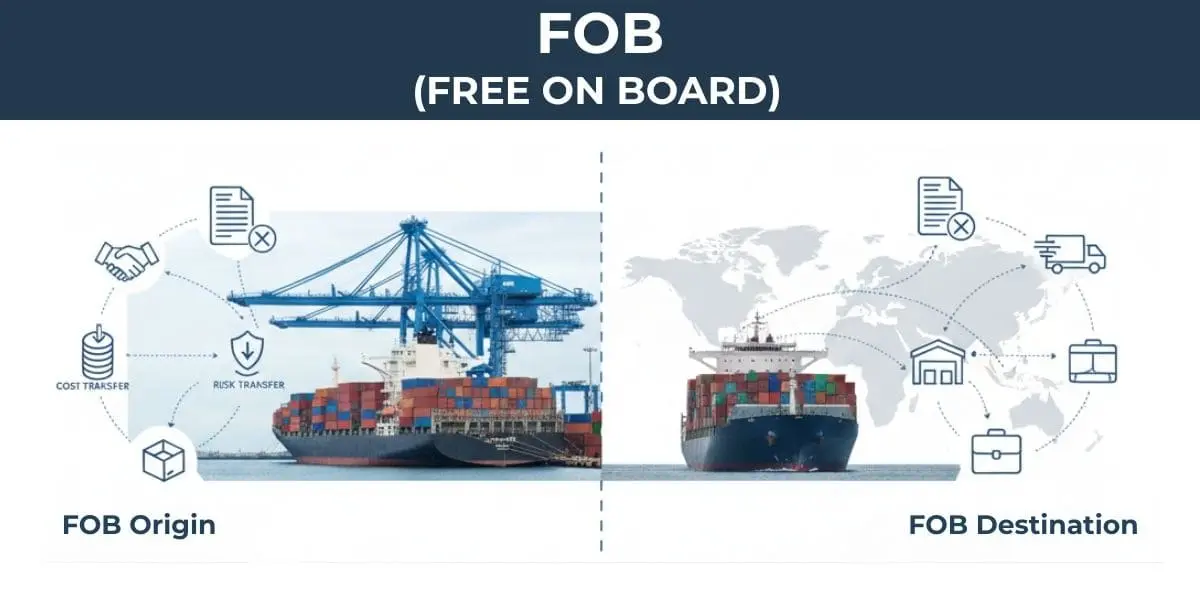
There are two main types of free onboard shipping. These are FOB Origin and FOB Destination:
FOB Origin: The buyer takes responsibility for the goods as soon as they are released from the dealer’s custody. After that, the buyer is also responsible for the risks and costs of delivery.
FOB Destination: The dealer is responsible till the goods reach the buyer’s location. The dealer is responsible for handling travel risks and shipping costs.
Difference between FOB Origin and FOB Destination
Here’s a clear distinction between Free on Board origin and destination.
| FOB Origin | FOB Destination |
| Transportation expenses from the seller’s location to the ultimate destination are the buyer’s responsibility. | Until it gets to the buyer’s location, the seller is liable for the expense of transportation. |
| From the seller’s location, the buyer organises and covers the shipment. | Up to delivery at the buyer’s location, the seller organises and covers shipping. |
| Because transportation outside of the seller’s location is not included, the price is typically lower. | Since shipping to the customer is included, the price is typically higher. |
| After the products leave the supplier, the buyer assumes the risk. | Until the items are delivered to the buyer, risk remains with the supplier. |
Benefits of FOB Origin
FOB Origin could be a suitable choice for buyers who want greater control. Merchandisers earn money because they shift a lot of responsibilities to the client. Let’s talk about the benefits of free onboard origin from the perspectives of both buyers and dealers.
Advantages for the Buyer
- Based on delivery time and cost, customers can choose carriers and routes. They also have the power to cut costs wherever possible.
- Buyers take on risk from the place of origin in addition to selecting the content and insurance provider.
- The buyer works directly with carriers for more efficient and well-coordinated delivery.
- The buyer can negotiate terms and costs with carriers.
Seller’s benefit
- The capacity of merchandisers to pass on tariffs and transportation costs to customers benefits dealers. They can concentrate more on dealing.
- The dealer’s responsibility lessens if the goods are taken out of their original location.
- Merchandisers may focus more on the products, finish order reversals faster, and handle fewer shipping tasks.
Disadvantages of FOB Origin
- Any damage, loss, or detention of the items once they are loaded for transit is entirely the buyer’s responsibility.
- For big shipments or long distances, the buyer may receive an advance on the FOB charges.
- Unnecessary costs such as insurance, paperwork, and customs clearance are the buyer’s responsibility.
Benefits of FOB Destination
FOB Destination enables merchandisers to give better service by holding them responsible for goods until they are delivered to the client. Additionally, buyers check the objects’ condition by admitting them before taking ownership. Let’s look at the benefits of free onboard destinations for both customers and sellers.
Benefits to the buyer
- There is no explicit shipping payment for customers. The cost of shipping is included in the purchase price.
- Because the dealer organises transportation, there is less paperwork and planning for the buyer.
- Until the items arrive at the buyer’s location, the dealer bears the risk.
Benefits of the dealer
- The dealer negotiates bulk pricing with carriers and controls shipping expenses.
- Throughout the whole journey, the dealer maintains control over the items.
- The dealer takes care of shipment immediately and quickly resolves problems.
Disadvantages of FOB Destination
- Until the items are delivered to the customer, the dealer is still in charge of them. The dealer is responsible for any loss, damage, or destruction that occurs during transportation.
- The dealer is responsible for handling any problems that arise during shipping, including replacing or paying for damaged items.
- Merchandisers may raise the final price in order to recoup charges, which may reduce the competitiveness of their offer.
Key Terms
To make the concept underlying the incoterm FOB clear, let’s give an example. Assume a company in Mumbai sells a client in Los Angeles, USA, around 2,000 handwoven hairpieces.
FOB The contract specifies origin: In this case, the Mumbai dealer prepares, packs, and loads the hairpieces onto the boat at Mumbai Port. Once the hairpieces are on board, the dealer’s job is done. After that, the buyer in Los Angeles takes total command and pays for all shipping costs, including freight, insurance, and customs clearance. Any threats made are also the customer’s responsibility.
FOB Shipping Point: Price Until the products arrive at the harbourage of origin, the merchant covers expenses. The buyer then pays for goods, taxes, customs duty, and other expenses.
FOB Location: In this instance, the dealer maintains control until the products arrive at the buyer’s location. Only then does the buyer become accountable.
FOB Destination: Price Transport costs are covered by the dealer until the products arrive at the buyer’s location. Any additional expenses are then borne by the customer.
Prepaid and Permitted Freight: During transportation, the dealer remains the owner and covers the freight costs.
Prepaid and Additional Freight: After delivery, the dealer adds the freight cost to the buyer’s account even though the dealer owns the items and pays the bill.
Collecting Freight: While the items are being transported, the dealer owns them; however, after the products enter the cargo, the customer is responsible for paying freight costs.
Collecting and Permitting Freight: While the items are being transported, the dealer covers the freight costs. The buyer reimburses the merchant for such costs when they get the products.
Key Takeaways
- The point at which the buyer assumes responsibility for the goods is known as FOB shipment.
- Once the products are loaded for transportation, the buyer assumes control under FOB origin.
- In the FOB destination, the dealer maintains control until the items arrive at the buyer’s location.
- Who is responsible for freight, insurance, and customs fees is determined by the incoterm FOB.
- These clauses also specify who is at risk of loss or damage when being transported.
Conclusion
FOB is more than just a shipping provision in a contract. It establishes the timing of the transfer of costs, risks, and item ownership between the dealer and the client. A detailed FOB agreement can help both parties prepare more efficiently and avoid misunderstandings. Regardless of whether the transaction is FOB Origin or FOB Destination, the terms must be understood before it is finished. Knowing how a FOB payload works will help you safeguard your interests and manage deals more wisely and confidently.