


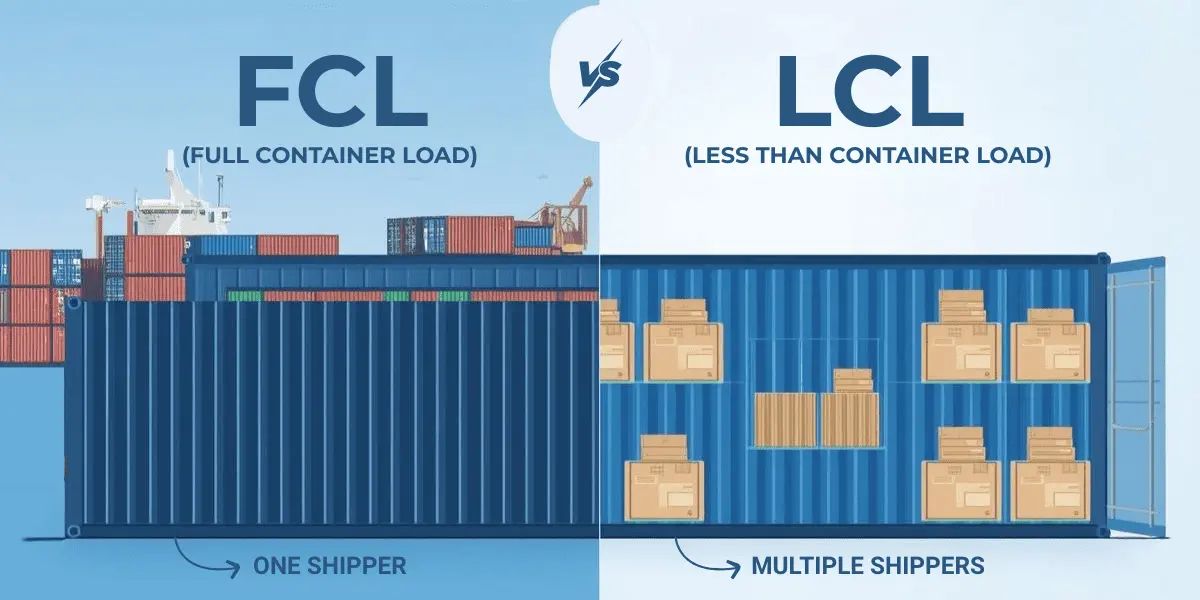
Learn the essentials of FCL and LCL shipping. Explore key differences, selection requirements, and real-life examples to optimize the shipping process.
When shipping products by sea, one of the first considerations is whether to rent a full container or share space with others. The choice made has far-reaching consequences for pricing, speed, freight safety, customs clearance, and overall logistics efficiency.
In this lesson, we will look at the key differences between Full Container Load and Less than Container Load, as well as the associated advantages and downsides, and how to decide which option is the most appropriate for the company you work for.
What is LCL (less than container load) shipping?
Numerous importers can share capacity in an identical container using less-than-container load (LCL) shipping. You just pay for the container space you use, as measured in cubic meters (CBM). The transportation logistics service supplier (LSP) is responsible for both the consolidation (combining the parcel with others to fill a cargo) and decontamination (removing the packaging and segregating the items being transported for distribution at the destinations).
This type of containerized transportation service is ideal for smaller loads that do not justify the expense of a complete container.
Choose LCL shipping for:
- Use LCL shipping for tiny or unexpected delivery quantities.
- Methods of delivery are flexible.
- Multiple destinations for deliveries
- Corporations shipping below fifteen cubic meters or 2-3 containers
Why choose an LCL?
- Suitable for very few mailings.
- Suitable for single loads or distributed loads.
- The frequent departures make it simple to make deliveries when needed.
What is FCL (Full Container Load) shipping?
Filled Container Load (FCL) transportation occurs when a container for transport has been fully booked and loaded by a single sender, even if the vessel is not quite filled. You pay a set charge for uninterrupted use of the package’s area, and your products are sealed from beginning to end.
FCL is often used for frequent, extremely valuable, or urgent shipping with smaller deliveries and a lower risk.
Choose FCL shipping for:
- FCL shipping is ideal for large-ticket cargoes (usually 15+ CBM).
- High-value or sensitive cargo
- If speed is a top concern, you require quicker times for transit.
Why choose an FCL?
- More secure, as the payload remains sealed during travel.
- Faster, more direct route with minimal interactions and no regrouping bottlenecks
- Competitive at quantity and decreased expenses per device.
Whatever your cargo number, using FCL might be more cost-effective, assuming your items do not fill the whole containers.
Key difference between LCL and FCL
Here’s a side-by-side comparison to assist you in selecting the appropriate choice depending on cargo size, urgency, and price range:
|
Factor |
LCL |
FCL |
|
Container usage |
Shared with several shippers. | Exclusive to one shipper. |
|
Cost model |
Pay by volume in cubic metres (CBMs). |
Fixed charge per container. |
|
Speed or travel time |
Slower, requires consolidation; more prone to delays. |
Faster, fewer pauses, and direct routes |
|
Security and Handling |
More handling equals increased risk exposure. |
Low risk, sealed from origin until delivery. |
|
Flexibility |
Highly suitable for multiple-location delivery. |
Limited to one container, one destination; higher availability during peak demand periods. |
|
Cost Considerations |
Lower upfront cost; gives savings on lesser volumes, but costs may rapidly increase if cargo grows. |
Economical for large shipments but requires a greater initial investment. |
|
Perfect for |
Small to mid-sized shipments (<15 CBM) with non-perishable, cost-sensitive, or low-risk contents. | Large, high-volume shipments (15-20 CBM or more); delicate, high-value, and/or regulated commodities |
Conclusion
The difference between LCL and goods carriers extends beyond corporation size and container capacity. Cost, speed, flexibility, and a comprehensive logistics plan are all critical concerns. LCL may be a more accessible starting point for small and medium-sized firms, especially if shipping volumes are gradually increasing. It increases flexibility and lowers upfront expenses. However, if your volume increases, shifting to FCL may result in lower unit transportation costs and faster delivery.
1 comment on “FCL vs LCL: Complete Guide for Importers & Exporters”